Introduction As the end of July approaches, many families are preparing for the back-to-school season…
What Is a 2-1 Interest Rate Buydown?
A 2-1 interest rate buydown is a mortgage option that temporarily lowers your interest rate for the first two years of your loan, helping you start with lower monthly payments before the rate returns to normal.
If you’re buying a home while interest rates are high, a 2-1 interest rate buydown can make your mortgage more affordable upfront. Your rate is reduced by 2% in the first year and 1% in the second year, then returns to the original rate for the rest of the loan term.
The seller, the lender, or both usually pay the cost of this temporary reduction. You still qualify for the full rate, and if rates drop later, any unused funds can be applied to your principal balance. It’s a practical way to ease into homeownership without locking yourself into a permanently higher payment.
How a 2-1 interest rate buydown works
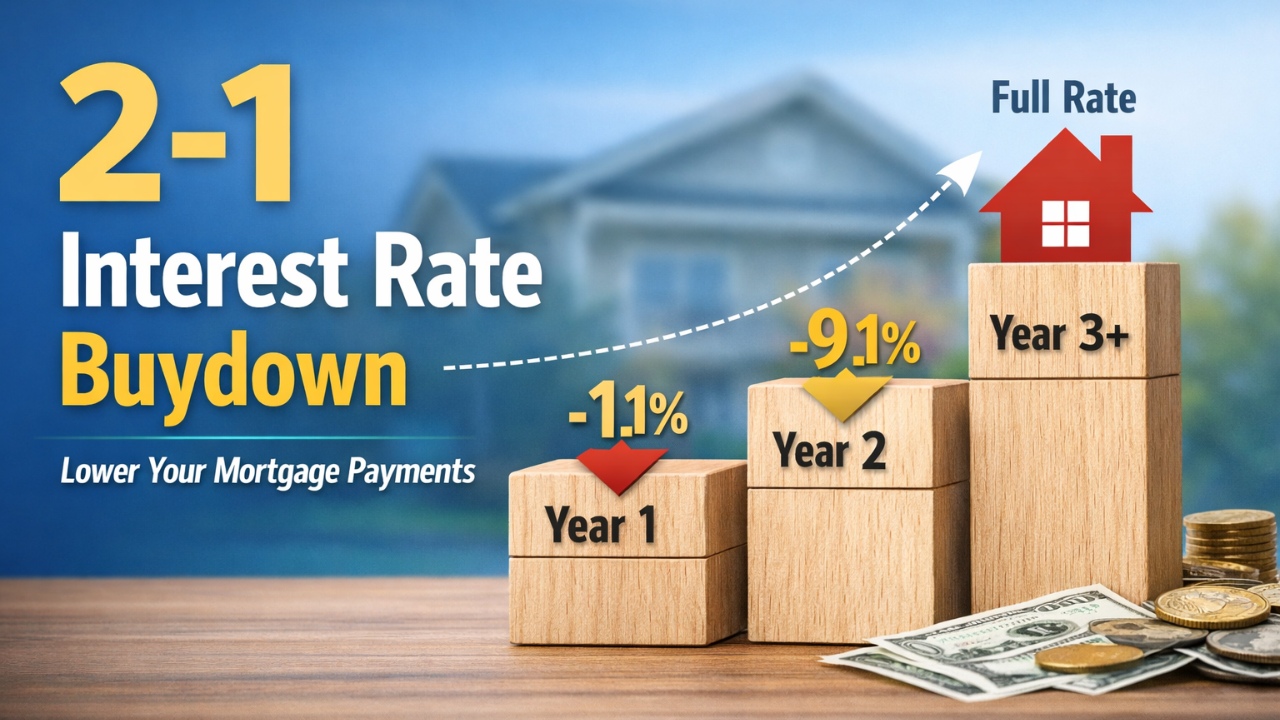
With a 2-1 interest rate buydown, the numbers are straightforward. The “2” represents a 2% reduction from your note rate in the first year. The “1” represents a 1% reduction in the second year. Starting in year three, your loan reverts to the full original interest rate.
For example, if your note rate is 7%, your effective rate would be 5% in year one, 6% in year two, and 7% from year three through the end of the loan. This structure is designed to give you breathing room in the early years of your mortgage, when moving and homeownership expenses are often highest.
Loan types and eligibility
A 2-1 interest rate buydown is available on conventional loans backed by Fannie Mae and Freddie Mac. It is limited to 15-year and 30-year fixed-rate mortgages and cannot be used with adjustable-rate loans.
This option is also available on government-backed loans such as FHA and VA conforming loans, though you cannot use it with FHA or VA high-balance loans.
The buydown applies only to purchase transactions and only for primary residences. You must still qualify for the mortgage at the full, non-discounted interest rate, just like any other standard home loan.
Eligible property types
You can use a 2-1 interest rate buydown on a wide range of property types, including single-family homes, condominiums, townhomes, planned unit developments, and even multi-unit properties. As long as you live in one of the units as your primary residence, the property can qualify.
2-1 interest rate buydown example
Imagine a $400,000 loan with a 7% interest rate on a 30-year fixed mortgage. Without a buydown, the monthly payment would be $2,661.
In the first year, the rate drops to 5%, reducing the payment to about $2,147. In the second year, the rate increases to 6%, with a payment of roughly $2,398. From year three onward, the rate returns to 7%, and the payment goes back to $2,661.
A subsidy covers the difference between the full and reduced payments. Over the first two years, that subsidy totals $9,323.16. The seller typically pays this amount as a concession, though in some cases the lender may also contribute.
Who pays for the buydown?
The cost of a 2-1 interest rate buydown is not added to your loan balance. Instead, it is funded upfront, most often by the seller. In today’s market, sellers frequently use this strategy to make their homes more attractive to buyers. And they don’t have to lower the purchase price.
What happens if interest rates drop
If interest rates fall during the first two years and you refinance or pay off the loan early, any remaining buydown funds are applied directly to your principal balance. That means you don’t lose the unused subsidy. You can either make lower upfront payments or reduce your loan balance later, making this a flexible, borrower-friendly option.
Why a 2-1 interest rate buydown can make sense?
A 2-1 interest rate buydown can be especially useful if you expect your income to increase, plan to refinance when rates drop, or want lower payments while adjusting to homeownership. It helps sellers move properties in a challenging market and gives buyers immediate payment relief without a long-term commitment to a higher rate.

Related Posts