Understanding the Mortgage Pre-Approval Process As we look forward to the brighter days of spring…
80-10-10 Mortgage With 10% Down: A Simple Case Study Explained
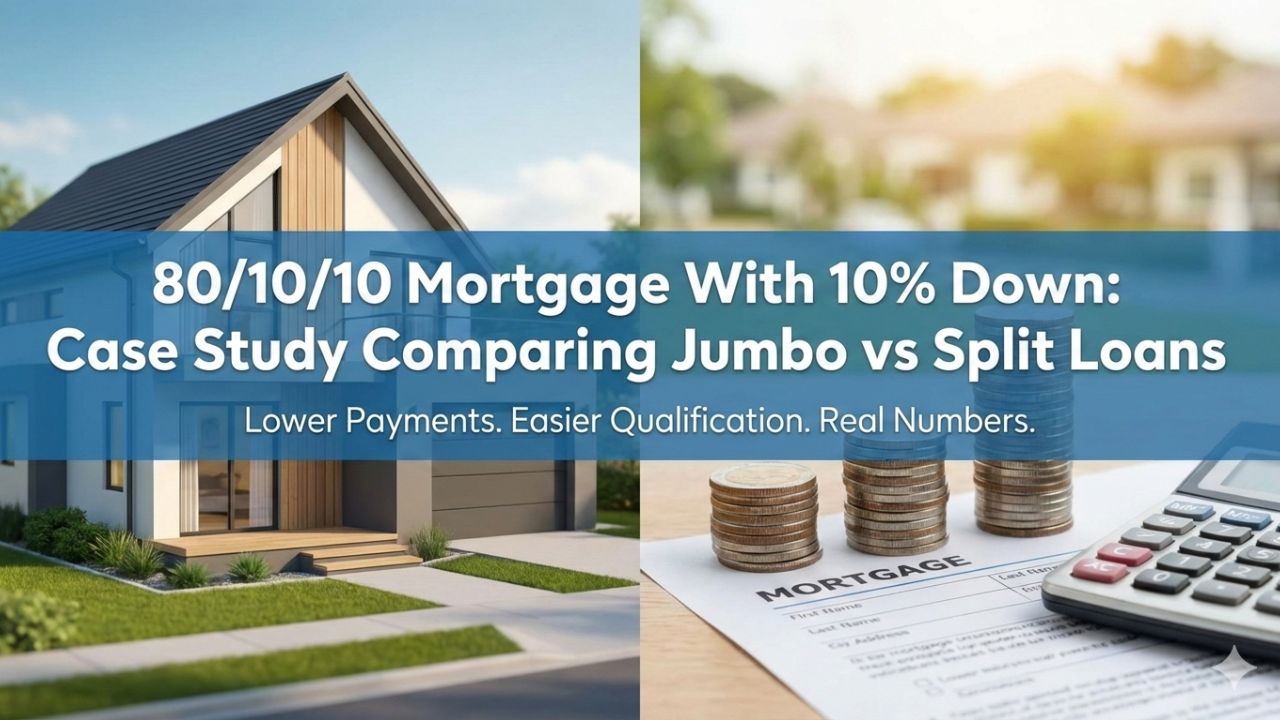
An 80/10/10 mortgage with 10% down lets you buy a home by splitting your loan into two mortgages rather than using a single jumbo loan, often resulting in lower monthly payments and easier qualification.
In this guide, you’ll learn how an 80/10/10 mortgage works, why buyers with only 10% down sometimes choose it over a jumbo loan, and how adjusting the split to a 70/20/10 structure can reduce monthly payments even further.
Using a real purchase price example, we compare interest rates, blended rates, and monthly payments across three options: 80/10/10, 70/20/10, and a jumbo loan. You’ll also understand why conforming loans are easier to qualify for, why jumbo loans usually cost more, and which option delivers the best overall value in this scenario.
What Is an 80/10/10 Mortgage?
An 80/10/10 mortgage is a home-buying strategy where you finance a property using
- 80% as a first mortgage
- 10% as a second mortgage or HELOC
- 10% as your down payment
Instead of putting down 20% or taking out a single jumbo loan, you split the financing into two loans. This approach is often used when the purchase price is slightly above the conforming loan limit.
The Case Study Purchase Price
In this example, the home purchase price is $937,500, which is just above the standard conforming loan limit in many areas. That’s why splitting the loan into a first and second mortgage becomes attractive.
With 10% down, the total loan amount is $843,750, structured in different ways to compare outcomes.
Option 1: 80/10/10 Mortgage With 10% Down
Here’s how the standard 80/10/10 structure looks
- First mortgage (80%): conforming loan
- Second mortgage (10%): HELOC
- Down payment: 10%
In this scenario,
- First mortgage rate: 7.75%
- Second mortgage rate (HELOC): 8.99%
- Blended interest rate: 7.88%
- Monthly payment (principal, interest, taxes, insurance): $6,750
This option avoids jumbo financing while keeping the first mortgage within conforming limits.
Option 2: 70/20/10 Mortgage (Lower Monthly Payment)
By slightly adjusting the structure, the numbers improve.
Instead of 80/10/10, this option uses
- 70% first mortgage
- 20% second mortgage
- 10% down
Even though the second mortgage is larger, the first mortgage qualifies for a better interest rate.
Results:
- First mortgage rate: 7.25%
- Second mortgage rate: 8.99%
- Blended interest rate: 7.637%
- Monthly payment: $5,881.47
This structure delivers the lowest monthly payment in the case study.
Option 3: Jumbo Loan With 10% Down
The third option is to use a single jumbo loan for the full $843,750.
In most U.S. markets
- Jumbo loans require stronger credit
- Reserves are often mandatory
- Interest rates are higher, especially with 10% down
In this example:
- Jumbo loan rate: ~8.5%
- Monthly payment: $6,487
This payment is higher than the 70/20/10 option and is subject to stricter qualification rules.
Costs Not Included in This Comparison
To keep the comparison clean and easy to understand, this case study excludes
- Closing costs
- Prepaid taxes
- Prepaid insurance
Only down payment and monthly loan costs are compared to highlight structural differences between loan types.
Best Option Based on This Case Study
For a $937,500 purchase price with 10% down, the 70/20/10 mortgage provides the best outcome
- Lowest monthly payment
- Better blended interest rate
- Easier qualification than a jumbo loan
Keeping the first mortgage within conforming limits reduces reserve requirements and underwriting conditions, making approval more flexible.
Why Jumbo Loans Are Harder Right Now
With jumbo financing
- Lenders typically require higher credit scores
- Cash reserves are mandatory
- Interest rates are noticeably higher
- 10% down jumbo loans are rare and expensive
In many cases, splitting the loan avoids these hurdles altogether.
Who Should Consider an 80/10/10 or 70/20/10 Mortgage?
This strategy works well if
- You’re buying slightly above the conforming loan limit
- You only want to put 10% down
- You want lower monthly payments
- You prefer easier qualification over jumbo loans
These structures can even work in high-cost areas using high-balance conforming first mortgages paired with a HELOC.
Final Thoughts
You can significantly reduce your monthly payments compared to jumbo financing using an 80/10/10 mortgage with 10% down or even a 70/20/10 structure. For buyers near the conforming loan limit, splitting the loan is often the smartest and most cost-effective move.

Related Posts